Quick Summary
Selling property in Dubai involves a defined sequence of steps overseen by the Dubai Land Department, from appointing a RERA-registered agent and signing Form A, through to the NOC and final ownership transfer. The market is active, with 61,437 transactions registered in 2026 year to date worth AED 184.6 billion. Apartments are the most liquid asset class, accounting for over 80% of all sales. A well-priced apartment in an active community can sell within 30 to 60 days. Fees for the seller typically include agent commission of 2%, a developer NOC fee of AED 500 to AED 5,000, and a DLD admin fee of AED 2,100 to AED 4,200. There is no capital gains tax on property sales in Dubai.
Is Now a Good Time to Sell Property in Dubai?
By most measures, yes. Dubai’s property market has registered 61,437 transactions worth a combined AED 184.6 billion in 2026 year to date, according to Property Monitor. That volume reflects a market with genuine depth and active buyer demand across multiple price tiers.
The most active price corridor in the market is AED 1 million to AED 2 million, accounting for over 39% of all transactions. If your property sits in that range, you are selling into the busiest segment of the Dubai market.
Seasonally, January to March sees the highest buyer activity, driven by cooler weather, an influx of international visitors, and global events bringing high-net-worth buyers to the city. That said, Dubai’s transaction volumes remain strong year-round in a way that most comparable global cities do not match.
What Is My Property Worth? Current Dubai Sale Prices in 2026
Before you set an asking price, it helps to understand where the market actually is. The following average sale prices are drawn from Property Monitor’s 2026 year-to-date sales data across all registered transactions in Dubai.
By bedroom type (averages):
- Studio: AED 783,036 average sale price (AED 1,891/sq ft)
- 1 Bedroom: AED 1,509,641 (AED 1,905/sq ft)
- 2 Bedroom: AED 2,724,283 (AED 2,048/sq ft)
- 3 Bedroom: AED 4,961,090 (AED 2,079/sq ft)
- 4 Bedroom: AED 6,033,139 (AED 1,644/sq ft)
- 5 Bedroom: AED 10,503,818 (AED 1,821/sq ft)
By property type, the average price per sq ft breaks down as follows:
- Apartments at AED 1,993/sq ft
- Villas at AED 2,237/sq ft
- Townhouses at AED 1,381/sq ft
These are averages across all areas and specifications. Location, floor level, view, finishing quality, and building management all shift individual unit values considerably. For a more granular benchmark, the Dubai Land Department‘s transaction portal publishes registered sale prices by area and unit type, allowing you to compare your property against what has actually sold nearby rather than what is currently listed.
Overpricing at launch is one of the most common and costly mistakes sellers make in Dubai. Properties that sit on the market for more than 60 days accumulate a visible listing history on portals, which buyers use as leverage to negotiate downward.
Is It Easy to Sell Property in Dubai?
It depends significantly on what you own. Dubai’s property market is not uniformly liquid, and the transaction data makes that clear.
Apartments account for 50,343 of the 61,437 total transactions registered in 2026 year to date, according to Property Monitor. Villas account for just 3,697. One-bedroom apartments alone represent 35.4% of all transactions in the market. If you own a one or two-bedroom apartment in a community with strong demand, a well-priced unit should attract offers within weeks.
Villas and larger units are a different story. The market exists and prices have risen strongly, but the buyer pool is smaller, due diligence takes longer, and the time from listing to transfer is typically extended. Sellers of villa units should budget for a 60 to 120 day sales cycle as a realistic expectation rather than an exception.
How to Sell Property in Dubai: Step by Step
The Dubai Land Department oversees all property transactions in the emirate. Every sale must be registered with the DLD, and the process follows a defined sequence regardless of whether you use an agent or sell privately.
Get Your Documents Ready
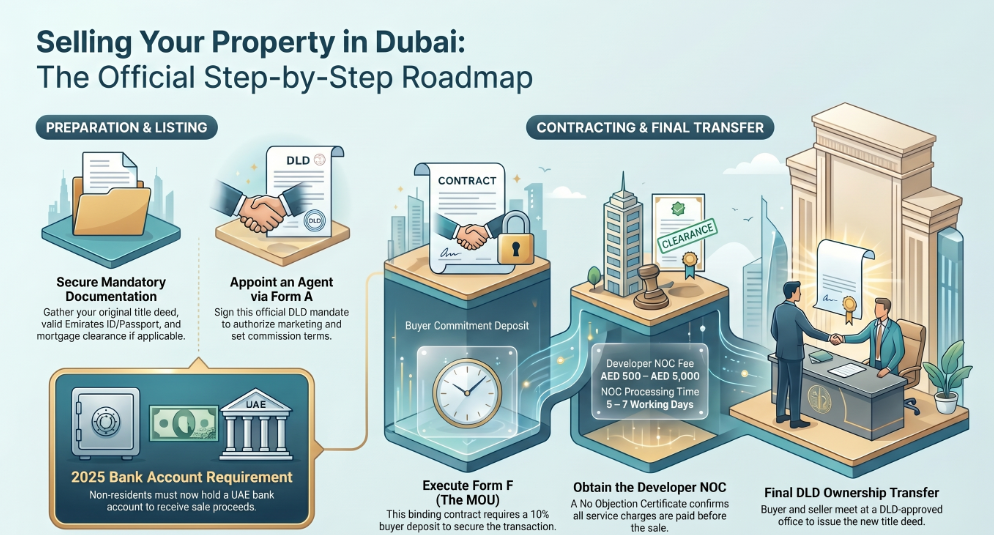
Before you list, have the following in order: your original title deed (or Oqood certificate for off-plan properties), your Emirates ID or passport with valid residency visa, a clearance certificate confirming no outstanding service charges, and if the property carries a mortgage, your mortgage documentation and confirmation from the bank of the outstanding balance.
Non-residents should note that a 2025 DLD ruling requires sellers to hold a UAE bank account in order to receive sale proceeds. If you are selling from abroad, factor in the time needed to establish this.
Set the Right Asking Price
Use registered transaction data from the DLD portal and current listing activity on Bayut and Property Finder to establish a realistic price range. Price at the top of that range if your property is genuinely differentiated by view, floor level, or finishing. Price at the midpoint if you want to move quickly.
Find a RERA-Registered Agent and Sign Form A
Engaging a RERA-registered agent is the standard route for most sellers. Verify any agent’s credentials via the Dubai REST app or the DLD’s online verification tool before signing anything. Once agreed, you will sign Form A, the official mandate authorising the agent to market your property. Form A includes commission terms, listing details, and the asking price. It is submitted to the DLD’s Trakheesi system, which issues a permit number for advertising.
List and Market the Property
Your agent will list the property across the major portals: Bayut, Property Finder, and dubizzle. Quality of presentation matters more than most sellers expect. Professional photography, accurate floor plans, and a well-written description meaningfully affect how quickly a property attracts serious enquiries. The property should be clean, decluttered, and well-lit for all viewings.
Receive and Negotiate Offers
Buyers submit offers either directly or through their own agent. Your agent manages negotiations on your behalf. Once a price is agreed, move to the next step promptly. Deals that linger after verbal agreement frequently fall apart.
Sign the MOU (Form F)
Form F, the Memorandum of Understanding, is the binding sales contract between buyer and seller. It sets out the agreed price, payment terms, transfer date, and all relevant conditions. Both parties sign it, witnessed by the agent. At this stage the buyer pays a deposit, typically 10% of the purchase price, as commitment to the transaction. Read Form F carefully before signing. All terms are enforceable once both signatures are in place.
Apply for the NOC from Your Developer
A No Objection Certificate from the property developer is required before the DLD will process the transfer. The NOC confirms that all service charges and outstanding fees on the property have been settled and the developer has no objection to the sale proceeding. NOC fees vary by developer and typically range from AED 500 to AED 5,000. Processing usually takes five to seven working days. You will need your title deed, a copy of Form F, and your Emirates ID or passport to apply.
Transfer Ownership at the DLD
The final step takes place at a DLD-approved trustee office, where buyer, seller, and agents attend in person. The buyer presents the balance payment, the seller pays the applicable transfer fees, and the DLD issues a new title deed in the buyer’s name. The transaction is officially recorded and the sale is complete.
What Are the Fees for Selling Property in Dubai?
Understanding the full cost of selling before you set your net price expectation is essential. Here is a clear breakdown.
- Agent commission: typically 2% of the sale price, paid by the seller. VAT at 5% applies to the commission unless otherwise agreed in writing.
- NOC fee: AED 500 to AED 5,000 depending on the developer. Paid by the seller. Check your developer’s current schedule directly, as fees vary.
- DLD transfer fee: 4% of the sale price. In practice this is often negotiated between buyer and seller, with each party bearing 2%, though this is not a legal requirement and varies by transaction. Confirmed on the DLD fee schedule.
- DLD admin fee: AED 2,100 for properties sold below AED 500,000. AED 4,200 for properties sold above AED 500,000.
- Mortgage discharge fee: AED 1,000 if the property carries an outstanding mortgage.
- Capital gains tax: none. Dubai does not levy capital gains tax on property sales. Sellers from countries including the UK, US, and Australia may still have home jurisdiction tax obligations on foreign property gains and should take independent tax advice.
Can You Sell a Property with a Mortgage in Dubai?
Yes, but the process involves an additional layer. Your bank becomes a party to the transaction and must issue a liability letter confirming the outstanding balance. The buyer’s funds, or their bank’s funds if they are purchasing with a mortgage, are used to settle your outstanding loan first. Once the mortgage is discharged, the bank issues a clearance letter and releases the original title deed, enabling the DLD transfer to proceed.
If both buyer and seller have mortgages, the transaction involves two banks and requires careful sequencing. An experienced agent and, where appropriate, a property solicitor will manage this coordination. Budget for the AED 1,000 mortgage discharge fee in your cost calculations. For official guidance on mortgaged property transfers, refer to the Dubai Land Department. You can find more details about selling a mortgaged property here.
How to Sell Off-Plan Property in Dubai
Selling an off-plan property, one that has not yet been handed over by the developer, follows a different process to a completed unit.
Instead of a title deed, off-plan properties are registered under an Oqood certificate issued by the DLD. The NOC requirement still applies, and some developers restrict resale until a defined percentage of the payment plan has been completed, often 30% to 40% of the total purchase price. Check your original sale and purchase agreement for any such restrictions before marketing the property.
The sale is structured as an assignment of contract rather than a title transfer. The buyer assumes your position in the payment plan, taking on responsibility for any remaining instalments due to the developer. The DLD registers the assignment and issues a new Oqood in the buyer’s name.
Off-plan resale values depend heavily on how much the project has appreciated since your original purchase and how close to completion it is. Units in projects nearing handover in desirable communities typically command the strongest premiums.
Can I Sell My Property Without an Agent in Dubai?
There is no legal requirement to use an agent. A private sale is permitted, and some sellers with direct access to buyers choose this route to avoid the 2% commission.
In practice, the process still requires a Trakheesi listing permit if you advertise the property, and the full DLD process including Form F, the NOC, and the trustee office transfer applies regardless. Without an agent, you are responsible for managing viewings, negotiations, paperwork, and coordination between all parties yourself.
Private sales work most cleanly when you already have a buyer, the transaction is straightforward, and both parties are comfortable managing the DLD process or have legal representation to assist. For open-market listings, the reach and process knowledge an experienced agent provides typically justifies the commission.
How to Sell Your Dubai Property Quickly
Price it accurately from day one. Properties launched at realistic market prices based on current registered transaction data from the DLD portal, rather than aspirational asking prices, attract serious buyers faster and avoid the stigma of a listing that has been sitting unsold.
Presentation matters. Professional photography, a complete and accurate listing, and a well-maintained property ready for viewing at short notice all reduce the time between listing and offer.
List across all three major portals simultaneously: Bayut, Property Finder and dubizzle. Visibility across all platforms maximises your buyer reach from day one.
Work with an agent who is active in your specific community rather than a generalist. An agent with recent transactions in your building or area has an existing buyer database and understands the pricing nuances that a broader agent may not.
Be open to receiving sale proceeds across multiple cheques rather than one. This widens your buyer pool and can accelerate closing.
How Long Does It Take to Sell Property in Dubai?
For a well-priced apartment in an active community, a realistic timeline from listing to transfer is 30 to 60 days. That accounts for marketing time, negotiation, NOC processing of five to seven working days, and the DLD transfer appointment.
Villas and larger properties typically take longer. With a smaller buyer pool, more extensive due diligence, and often more complex financing arrangements on the buyer side, 60 to 120 days is a more realistic expectation.
The DLD transfer itself, once all parties are ready and the NOC is in hand, is typically completed on the same day at the trustee office.
FAQs
Is it easy to sell a property in Dubai?
For apartments in the AED 1 million to AED 2 million range, yes. This is the most active price band in the market and apartments account for over 80% of all transactions registered in 2026 year to date, according to Property Monitor. Villas and larger units have a smaller buyer pool and take longer, but the market for premium properties remains active and prices have been rising.
Can I sell my property without an agent in Dubai?
Yes, there is no legal mandate to use one. However, the full DLD process still applies and you will need to manage all aspects of marketing, negotiation, and documentation yourself. Most sellers find the 2% commission a worthwhile cost against the complexity involved.
What is the quickest way to sell a property in Dubai?
Price it at market from day one using current DLD transaction data, present it well, list it across all major portals simultaneously, and work with an agent who has active buyers in your specific community.
Can I sell a mortgaged property in Dubai?
Yes. Your bank issues a liability letter, the outstanding mortgage is cleared from the buyer’s funds at transfer, the bank provides a clearance letter, and the DLD transfer proceeds. It adds steps but is a routine transaction.
Do I need an NOC to sell my property in Dubai?
Yes. A No Objection Certificate from your developer is required before the DLD will register the transfer. It confirms no outstanding service charges or liabilities on the property.
Does Dubai charge capital gains tax on property sales?
No. There is no capital gains tax on property transactions in Dubai. Sellers from certain countries may have obligations in their home jurisdiction and should seek independent advice.
Do I need a UAE bank account to sell as a non-resident?
Yes, under rules introduced by the DLD in 2025, non-resident sellers are required to hold a UAE bank account to receive sale proceeds. Factor in the time needed to open one if you are selling from abroad.
Ready to Sell? Talk to Vibgyor Real Estate
Whether you are selling your first investment property or managing a larger portfolio exit, Vibgyor Real Estate brings current market knowledge, RERA-registered agents, and hands-on experience across Dubai’s residential market to every transaction.
Get in touch with Vibgyor Real Estate to discuss your sale strategy and receive a no-obligation market appraisal, via WhatsApp or submit your property details here for analysis.
Data source: Property Monitor Overall Sales Analysis, 2026 year to date (as of May 2026).